ePoster

QR unavailable
Share ePoster
Scan or copy the public World Wide URL.
ePoster
COMPARATIVE THERAPEUTIC EFFICACY OF AAV9-GALC AT DIFFERENT INJECTION TIME POINTS AND PROMOTERS IN THE TWITCHER MURINE MODEL OF KRABBE DISEASE
Minju Kangand 2 co-authors
Yonsei University College of Medicine
FENS Forum 2026 (2026)
Barcelona, Spain
Presenter and authors
Presenter
Minju Kang
Yonsei University College of Medicine
Co-authors
Jung Hwa Seo; Sung-Rae Cho
Abstract
Krabbe disease is a fatal lysosomal storage disorder caused by galactosylceramidase (GALC) deficiency, leading to psychosine accumulation and demyelination in the central and peripheral nervous systems (CNS and PNS). We investigated how injection time points and promoter specificity affect the efficacy of systemic adeno-associated virus serotype 9 (AAV9)-mediated GALC gene therapy.
An AAV9 vector encoding GALC under either the ubiquitous CBA promoter or the oligodendrocyte-enriched myelin basic protein (MBP) promoter was administered intraperitoneally to Twitcher mice at postnatal day 1 (P1) or postnatal day 10 (P10), with consideration of differences in CNS/PNS maturation. Therapeutic outcomes were evaluated using behavioral assessments, GALC enzyme activity, psychosine quantification, immunohistochemistry, and transmission electron microscopy (TEM).
Mice treated with AAV9-CBA-GALC at P10 exhibited pronounced functional improvement among all treatment groups, accompanied by the highest GALC enzyme activity and the greatest reduction in psychosine levels in both the CNS and PNS. This treatment resulted in robust restoration of GALC and MBP expression with widespread recovery of myelinated regions. TEM analysis confirmed superior ultrastructural myelin recovery in both the CNS and PNS. In contrast, MBP promoter-driven GALC delivery at P1 and P10 produced partial therapeutic effects, with improvements restricted to CNS regions, including a reduced g-ratio in the corpus callosum, while no significant recovery was observed in the sciatic nerve.
These findings demonstrate that the therapeutic efficacy of AAV9-mediated GALC gene therapy is strongly influenced by injection time points and cell-type distribution, emphasizing the importance of appropriately timed systemic strategies for treating Krabbe disease.
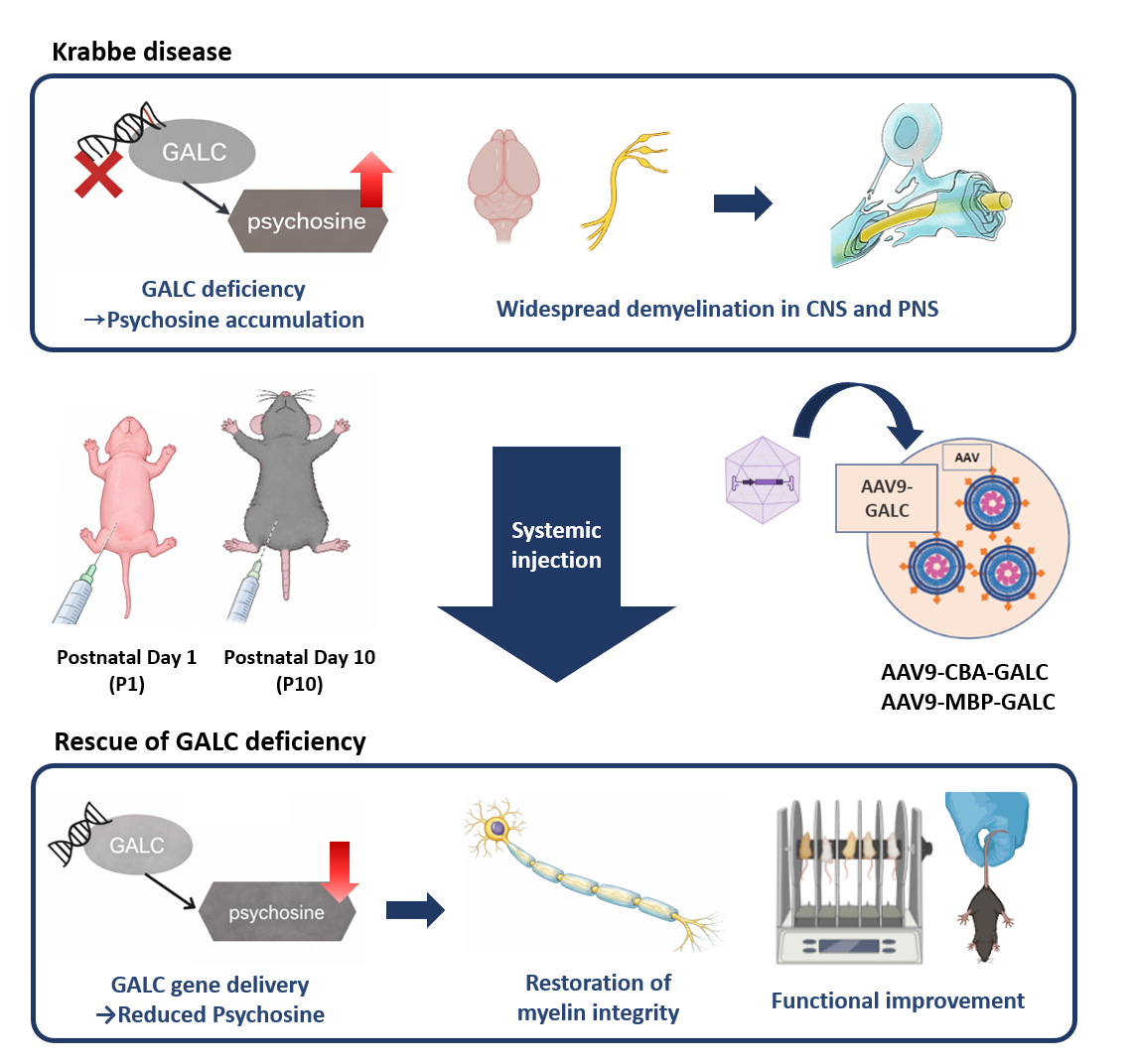
An AAV9 vector encoding GALC under either the ubiquitous CBA promoter or the oligodendrocyte-enriched myelin basic protein (MBP) promoter was administered intraperitoneally to Twitcher mice at postnatal day 1 (P1) or postnatal day 10 (P10), with consideration of differences in CNS/PNS maturation. Therapeutic outcomes were evaluated using behavioral assessments, GALC enzyme activity, psychosine quantification, immunohistochemistry, and transmission electron microscopy (TEM).
Mice treated with AAV9-CBA-GALC at P10 exhibited pronounced functional improvement among all treatment groups, accompanied by the highest GALC enzyme activity and the greatest reduction in psychosine levels in both the CNS and PNS. This treatment resulted in robust restoration of GALC and MBP expression with widespread recovery of myelinated regions. TEM analysis confirmed superior ultrastructural myelin recovery in both the CNS and PNS. In contrast, MBP promoter-driven GALC delivery at P1 and P10 produced partial therapeutic effects, with improvements restricted to CNS regions, including a reduced g-ratio in the corpus callosum, while no significant recovery was observed in the sciatic nerve.
These findings demonstrate that the therapeutic efficacy of AAV9-mediated GALC gene therapy is strongly influenced by injection time points and cell-type distribution, emphasizing the importance of appropriately timed systemic strategies for treating Krabbe disease.