ePoster
Loading poster PDF…
QR unavailable
Share ePoster
Scan or copy the public World Wide URL.
ePoster
COMPUTATIONAL ANALYSIS OF ACOUSTIC RADIATION FORCE AND STRAIN MECHANISMS FOR ULTRASOUND NEUROMODULATION
Ryo Segawaand 2 co-authors
Ghent University-imec
FENS Forum 2026 (2026)
Barcelona, Spain
Presenter and authors
Presenter
Ryo Segawa
Ghent University-imec
Co-authors
Emmeric Tanghe; Thomas Tarnaud
Abstract
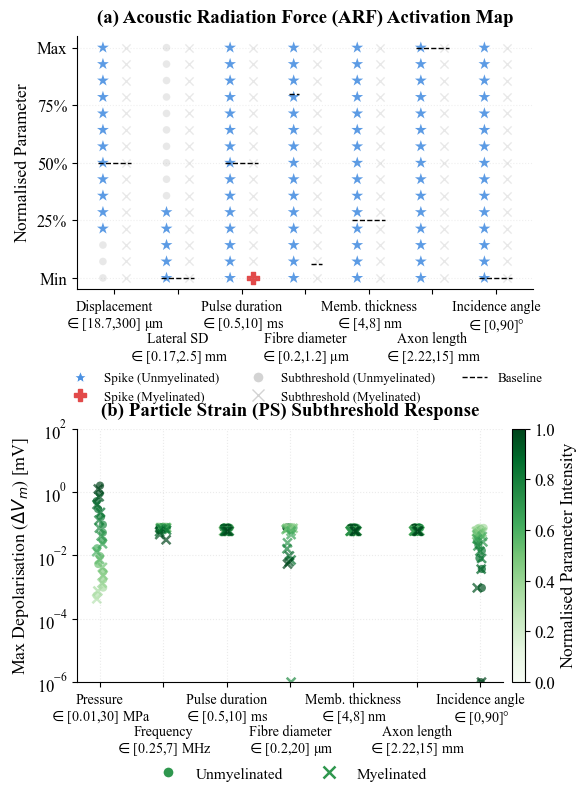
Ultrasound neuromodulation holds transformative potential as a non-invasive treatment for neurological disorders, yet the biophysical mechanisms driving neuromodulation remain debated. This study systematically investigates morphological deformation effects induced by acoustic radiation force (ARF) and particle strain (PS), isolating mechanisms arising from membrane mechanics. We employ a multi-scale computational framework to simulate the electrophysiological dynamics across cell types: from unmyelinated (C-fibre) and myelinated (A-fibre) peripheral axons to morphologically realistic models of cortical and hippocampal neurons. To model mechanical effects, we use a charge-based equation where membrane capacitance, membrane resistance, and axial resistance vary spatiotemporally due to ARF and PS. We systematically map activation thresholds across a comprehensive acoustic parameter space. We determine how acoustic incidence angle and intrinsic morphological properties—specifically membrane thickness and cellular dimensions—dictate the acoustic intensity required for neuromodulation. Our results indicate a distinct sensitivity between fibre types (see the attached figure). ARF-driven deformation robustly triggers action potentials in the unmyelinated axon across a wide range of displacement amplitudes and pulse durations. Conversely, the myelinated axon exhibits relative insensitivity. On the other hand, the results of our axon simulations also demonstrate that PS causes negligible depolarisation even throughout the extensive parameter space. Furthermore, we will assess the comparative sensitivity of these distinct neuronal populations to ARF-driven versus PS-driven deformation. These findings provide a theoretical basis for ultrasound-induced morphological deformation by ARF and PS, clarifying which neural targets are susceptible to this mechanism under clinically safe acoustic protocols.