ePoster
Loading poster PDF…
QR unavailable
Share ePoster
Scan or copy the public World Wide URL.
ePoster
L-CARNITINE AND LINOLEIC ACID RESCUES PATHOLOGICAL IRON ACCUMULATION AND LIPID PEROXIDATION IN CELLULAR MODELS OF NEMALINE MYOPATHY
Alejandra López Cabreraand 2 co-authors
Centro Andaluz de Biología del Desarrollo/ Universidad Pablo de Olavide
FENS Forum 2026 (2026)
Barcelona, Spain
Presenter and authors
Presenter
Alejandra López Cabrera
Centro Andaluz de Biología del Desarrollo/ Universidad Pablo de Olavide
Co-authors
Rocío Piñero Pérez; José Antonio Sánchez Alcázar
Abstract
Nemaline Myopathy (NM) is a rare congenital muscle disorder characterized by muscle weakness and the presence of nemaline bodies. Pathogenic variants of Actin Alpha 1 (ACTA1) and Nebulin (NEB) genes are the main cause of NM.
We previously demonstrated that actin polymerization defects in patient-derived fibroblasts are associated with significant mitochondrial dysfunction. Since mitochondria are the primary site for iron–sulfur cluster and heme synthesis, mitochondrial dysfunction leads to a dysregulation of iron metabolism. Iron- reactive oxygen species (ROS) interactions trigger mitochondrial oxidative damage. Consequently, this oxidative environment fosters further iron accumulation and lipofuscin-likes aggregates, and increased lipid peroxidation, establishing a vicious cycle of organelle damage.
Interestingly, L-carnitine (LCAR) and linoleic acid (LA), two mitochondrial-boosting compounds, enhanced actin filament polymerization and restored mitochondrial bioenergetics. However, the underlying molecular mechanisms of these compounds are unknown. This study aims to bridge this gap by analyzing these compounds’ effect in restoring cellular iron homeostasis and mitigating oxidative damage in patient-derived NM fibroblast. L-carnitine and LA supplementation successfully rescued the pathological phenotype in ACTA1 and NEB pathogenic variants. Results show that treatment significantly reduced intracellular iron and lipofuscin-like aggregates observed by transmission electron microscopy (TEM). These compounds restored iron homeostasis by upregulating the expression levels of essential proteins for iron-sulfur cluster biogenesis, and normalizing transferrin receptor protein 1 and ferritin expression levels.
Cellular models of NM exhibit an iron-driven oxidative cascade. Targeting iron dyshomeostasis through L-carnitine and Linoleic Acid represents a promising therapeutic strategy, highlighting the importance of mitochondrial dysfunction in congenital neuromuscular diseases.
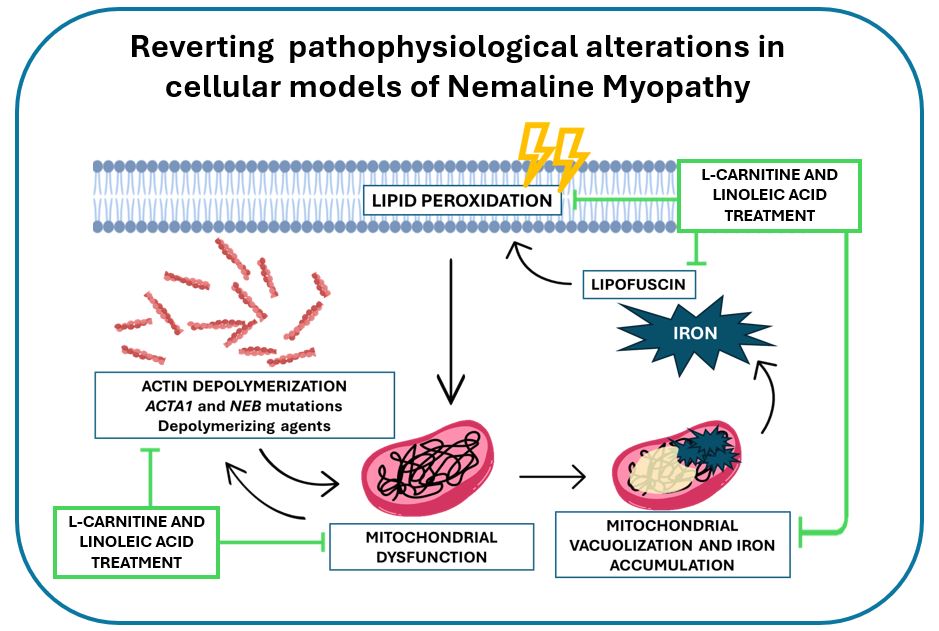
We previously demonstrated that actin polymerization defects in patient-derived fibroblasts are associated with significant mitochondrial dysfunction. Since mitochondria are the primary site for iron–sulfur cluster and heme synthesis, mitochondrial dysfunction leads to a dysregulation of iron metabolism. Iron- reactive oxygen species (ROS) interactions trigger mitochondrial oxidative damage. Consequently, this oxidative environment fosters further iron accumulation and lipofuscin-likes aggregates, and increased lipid peroxidation, establishing a vicious cycle of organelle damage.
Interestingly, L-carnitine (LCAR) and linoleic acid (LA), two mitochondrial-boosting compounds, enhanced actin filament polymerization and restored mitochondrial bioenergetics. However, the underlying molecular mechanisms of these compounds are unknown. This study aims to bridge this gap by analyzing these compounds’ effect in restoring cellular iron homeostasis and mitigating oxidative damage in patient-derived NM fibroblast. L-carnitine and LA supplementation successfully rescued the pathological phenotype in ACTA1 and NEB pathogenic variants. Results show that treatment significantly reduced intracellular iron and lipofuscin-like aggregates observed by transmission electron microscopy (TEM). These compounds restored iron homeostasis by upregulating the expression levels of essential proteins for iron-sulfur cluster biogenesis, and normalizing transferrin receptor protein 1 and ferritin expression levels.
Cellular models of NM exhibit an iron-driven oxidative cascade. Targeting iron dyshomeostasis through L-carnitine and Linoleic Acid represents a promising therapeutic strategy, highlighting the importance of mitochondrial dysfunction in congenital neuromuscular diseases.