ePoster

QR unavailable
Share ePoster
Scan or copy the public World Wide URL.
ePoster
SCALING DATA IN AUDITORY ATTENTION DECODING: AN EMPIRICAL ANALYSIS OF TRAINING DATA REQUIREMENTS
Iñigo Garciaand 4 co-authors
Universidad Pública de Navarra (UPNA)
FENS Forum 2026 (2026)
Barcelona, Spain
Presenter and authors
Presenter
Iñigo Garcia
Universidad Pública de Navarra (UPNA)
Co-authors
Ruben Eguinoa; Ricardo San Martín; Daniel Paternain; Carmen Vidaurre
Abstract
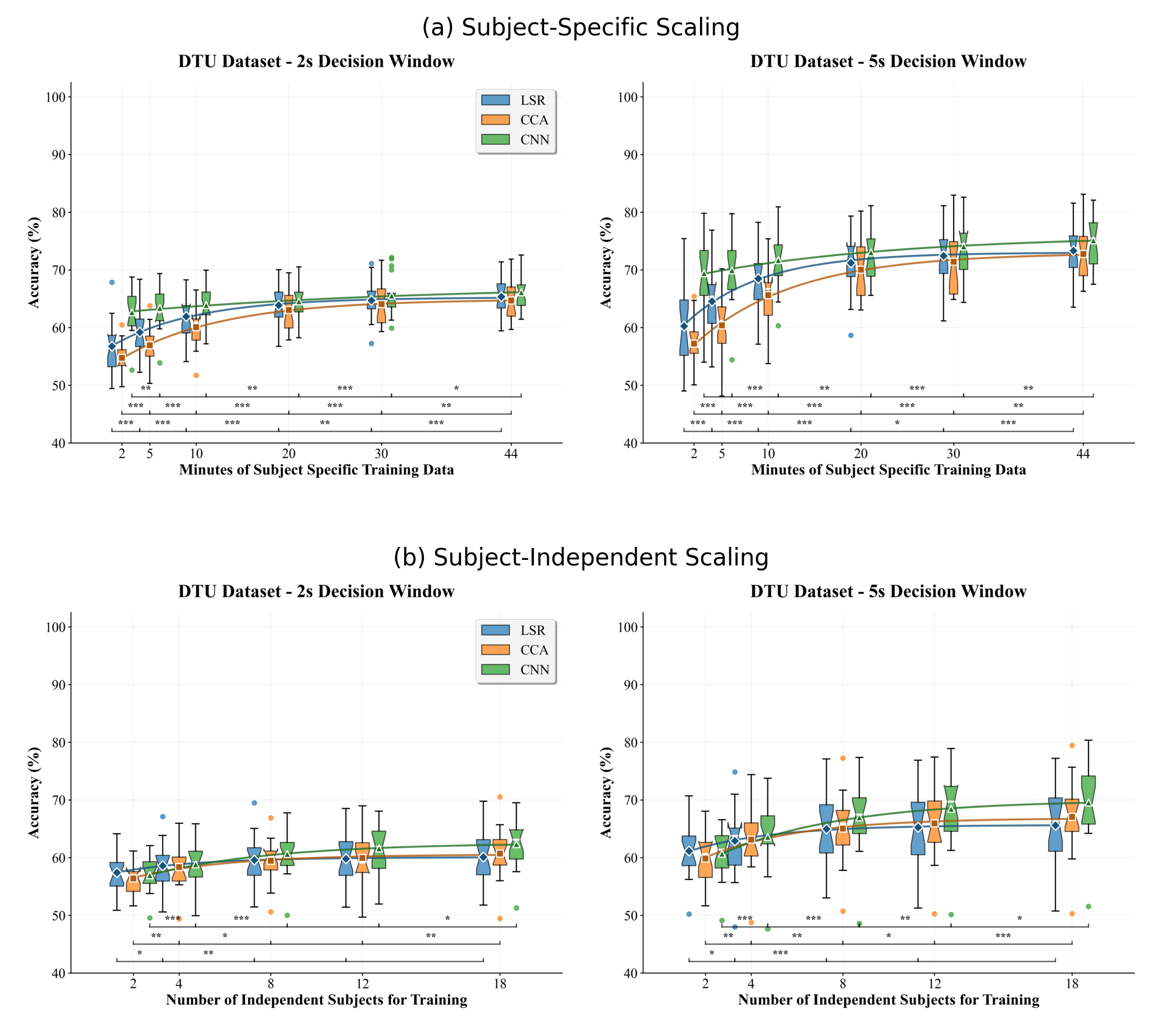
Auditory Attention Decoding (AAD) models aim to identify the attended auditory stimulus in multi-speaker environments by decoding electroencephalography (EEG) signals. These models are trained using either subject-specific or subject-independent data. In real-world applications, collecting these data is often necessary, as external AAD data may be ill-conditioned with respect to specific experimental or deployment settings. This process can be costly and time-consuming. Recent advances in AAD have increasingly turned toward nonlinear deep learning approaches, particularly Convolutional Neural Networks (CNNs), which generally outperform classical linear models but are believed to require larger amounts of training data due to their greater complexity. These considerations motivated us to perform a systematic study of how training data availability affects AAD performance using both linear and nonlinear models. In this work, we empirically compared three representative AAD methods—Linear Stimulus Reconstruction (LSR), Canonical Correlation Analysis (CCA), and a CNN-based model—across three datasets and evaluated their performance under progressively constrained training data conditions. For subject-independent decoders, results followed a power-law trend saturating beyond a limited number of subjects. As expected, linear methods—particularly LSR—saturated with less independent data. When scaling subject-specific data, similar power-law behavior appeared only for linear models, with LSR outperforming CCA in low-data regimes. Conversely, the CNN-based model trained with a pre-training and fine-tuning approach showed a near-linear performance increase, consistently surpassing linear methods when data were scarce. These findings provide practical insight into data requirements and efficiency in AAD, guiding both research design and clinical deployment.