ePoster
Loading poster PDF…
QR unavailable
Share ePoster
Scan or copy the public World Wide URL.
ePoster
A STRUCTURED MODEL SPACE FOR NEURAL POPULATION DYNAMICS IN EEG: FROM CANONICAL MODELS TO GRAMMAR-BASED DISCOVERY
Nina Omejcand 3 co-authors
Jozef Stefan Institute
FENS Forum 2026 (2026)
Barcelona, Spain
Presenter and authors
Presenter
Nina Omejc
Jozef Stefan Institute
Co-authors
Sabin Roman; Ljupčo Todorovski; Sašo Džeroski
Abstract
Neural population models are central to interpreting M/EEG signals, yet model choice remains largely ad hoc. The field lacks a principled way to relate, structure, and extend them.
We surveyed seventeen widely used neural mass and phenomenological population models (hereafter, canonical models) and compared them by equation structure and complexity. In parallel, we performed a functional analysis by fitting these single-node models to empirical resting-state and SSVEP EEG independent component time series. We then compared their spectral fits under a unified optimization and evaluation framework. Further, we decomposed the models into shared dynamical building blocks describing population dynamics and their interactions. Leveraging this decomposition, we constructed a domain-informed probabilistic grammar of model components, enabling systematic generation of new candidate models.
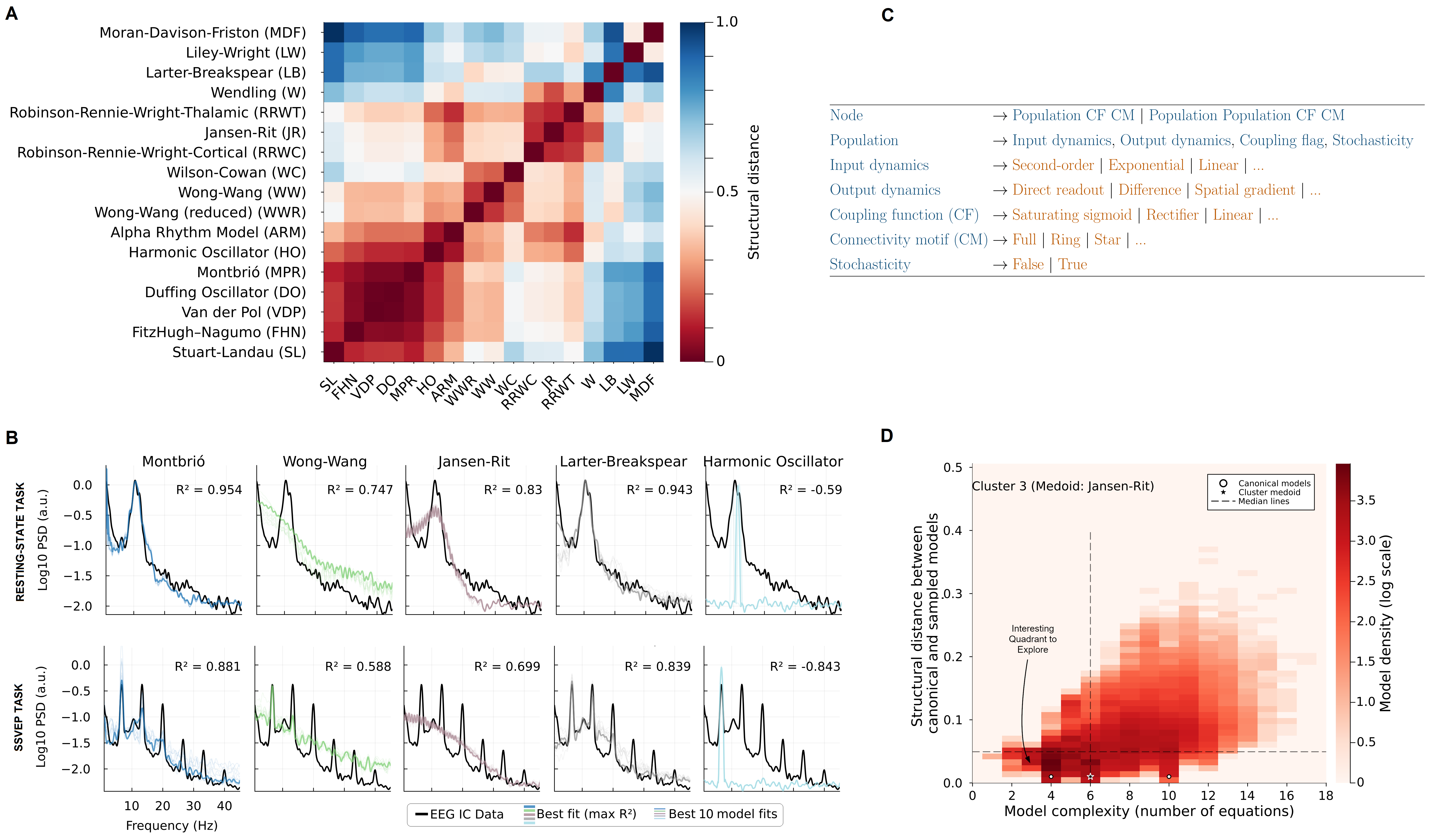
Structural analysis revealed six distinct clusters of canonical models that cut across phenomenological versus neural mass distinction (Figure 1A). Model fitting demonstrated systematic differences in how the models reproduce empirical EEG power spectra (Figure 1B), establishing a functional reference for the model space. Across both analyses, phenomenological models (Montbriό) tended to occupy the simplest regions of the model space and achieved the strongest spectral fits. Sampling from the grammar, shown in simplified form in Figure 1C, reproduces known canonical models and generates novel candidates that occupy intermediate and previously unexplored regions of the model space, positioned relative to established clusters by structural distance and complexity (Figure 1D).
Together, our work introduces an EEG-grounded space for principled, comparative, and data-driven exploration of neural population dynamics models.
We surveyed seventeen widely used neural mass and phenomenological population models (hereafter, canonical models) and compared them by equation structure and complexity. In parallel, we performed a functional analysis by fitting these single-node models to empirical resting-state and SSVEP EEG independent component time series. We then compared their spectral fits under a unified optimization and evaluation framework. Further, we decomposed the models into shared dynamical building blocks describing population dynamics and their interactions. Leveraging this decomposition, we constructed a domain-informed probabilistic grammar of model components, enabling systematic generation of new candidate models.
Structural analysis revealed six distinct clusters of canonical models that cut across phenomenological versus neural mass distinction (Figure 1A). Model fitting demonstrated systematic differences in how the models reproduce empirical EEG power spectra (Figure 1B), establishing a functional reference for the model space. Across both analyses, phenomenological models (Montbriό) tended to occupy the simplest regions of the model space and achieved the strongest spectral fits. Sampling from the grammar, shown in simplified form in Figure 1C, reproduces known canonical models and generates novel candidates that occupy intermediate and previously unexplored regions of the model space, positioned relative to established clusters by structural distance and complexity (Figure 1D).
Together, our work introduces an EEG-grounded space for principled, comparative, and data-driven exploration of neural population dynamics models.