ePoster


Share ePoster
Scan or copy the public World Wide URL.
ePoster
THE STEM CELL-EXCLUSIVE MIR-290-295 CLUSTER, UNEXPECTEDLY THE MOST SPECIFIC MICRORNAS IN MATURE DOPAMINE NEURONS WITHIN SUBSTANTIA NIGRA, CONFERS NEUROPROTECTION VIA PRESERVED PROTEIN SYNTHESIS
Zixuan Liand 9 co-authors
Shanghai Ninth People's Hospital, Shanghai Jiao Tong University School of Medicine
FENS Forum 2026 (2026)
Barcelona, Spain
Presenter and authors
Presenter
Zixuan Li
Shanghai Ninth People's Hospital, Shanghai Jiao Tong University School of Medicine
Co-authors
Yang Xu; Nicola Murgia; Nikolay Kovzel; Dick San Ng; Yu Liu; Xuejia Kang; Andrii Domanskyi; Wenjie Zhang; Ilya A. Vinnikov
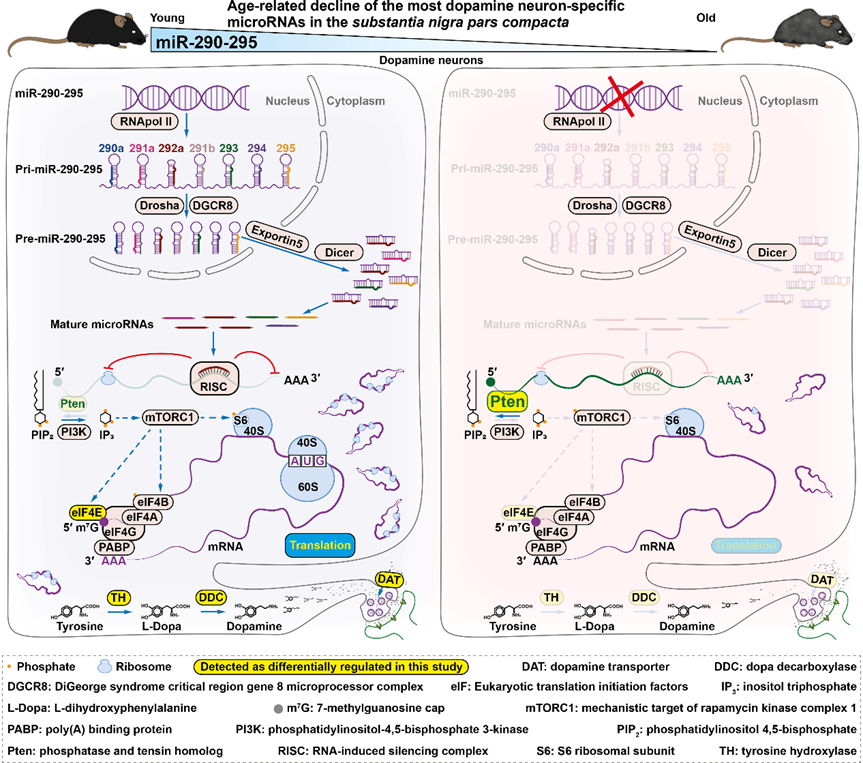
Abstract
Dopamine (DA) neurons in the substantia nigra pars compacta (SN) are critically involved in locomotor control, while their degeneration is a hallmark of Parkinson’s disease. During embryonic development, cells typically downregulate stemness-promoting microRNAs, such as the miR-290-295 cluster, upon terminal differentiation. Surprisingly, we identified that these embryonic microRNAs are highly and selectively expressed in adult SN DA neurons, though its expression significantly declines with aging. To investigate its physiological role, we generated genetic knockout models. While global deletion of the miR-290-295 cluster led to progressive SN DA neuron loss, the adult DA neuron-specific knock-out led to an early reduction in key DA biogenesis enzymes, including dopa decarboxylase and DA transporter, ultimately manifesting in late-onset locomotor deficits. Mechanistically, we determined that miR-292a-3p, the most abundant member of this cluster, directly targets and represses Pten, a primary antagonist of the PI3K-Akt-mTOR signaling pathway, which is essential for translation initiation and conveying protection of DA neurons. Using in vivo L-azidohomoalanine labeling to track de novo translation, we demonstrated that the loss of this microRNA cluster causes a severe impairment of protein synthesis within mature SN DA neurons. Notably, supplementing miR-292a-3p or silencing Pten effectively rescued these cluster knockout-associated decline in cell viability. These findings reveal an unexpected epigenetic mechanism where terminally differentiated neurons repurpose stem cell-specific microRNAs to preserve protein synthesis and maintain long-term neuroprotection.