ePoster
Loading poster PDF…
QR unavailable
Share ePoster
Scan or copy the public World Wide URL.
ePoster
TASK-DEPENDENT SPATIAL TRANSFORMATIONS SHAPE OPTIMAL VISUO-PROPRIOCEPTIVE INTEGRATION DURING MANUAL ACTIONS
Jules Bernard-Espinaand 2 co-authors
Université Paris-Saclay
FENS Forum 2026 (2026)
Barcelona, Spain
Presenter and authors
Presenter
Jules Bernard-Espina
Université Paris-Saclay
Co-authors
Mathieu Beraneck; Michele Tagliabue
Abstract
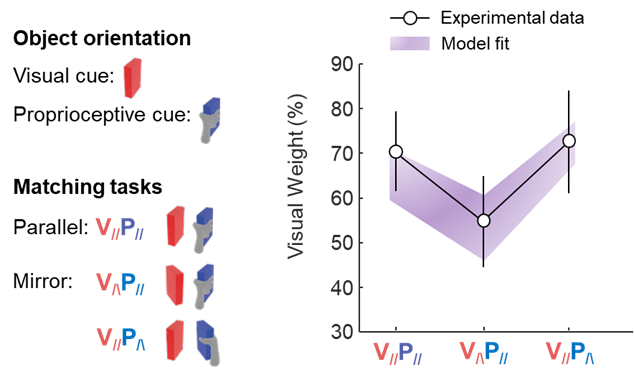
Aim: Accurate visuo-proprioceptive integration is essential for upper-limb motor control and is often impaired after stroke. Recent findings suggest that, when reaching or grasping an object, sensory information is encoded in multiple, parallel reference frames. In a previous study, we suggested that stroke lesions may impair cross-reference re-encoding of sensory information; for example, the re-encoding of joint proprioceptive signals into external visual space when patients reach for their thumb with eyes closed. While current theories of multisensory integration primarily attribute optimal sensory weighting to the relative precision of the available cues, we investigated whether task-dependent sensory re-encoding also modulates this process. Method and Results: A virtual reality setup was combined with a robotic haptic device that passively moved the participant’s hand, providing proprioceptive information. Healthy participants performed object orientation matching tasks in two conditions: parallel tasks (same orientation) and mirror tasks (symmetric across the sagittal plane). Mirror tasks required the re-encoding of sensory signals across reference frames. Tasks were performed using proprioceptive-only, visual-only, or combined visuo-proprioceptive information. Results showed that the need for sensory re-encoding increased performance variability in both proprioceptive and visual conditions. In visuo-proprioceptive conditions, participants down-weighted the sensory cue requiring cross-reference re-encoding. We propose a novel model of optimal multi-sensory integration that accounts for these findings. Conclusion: These findings demonstrate that task-dependent spatial transformations affect multisensory visuo-proprioceptive integration. Our results refine existing theoretical models and have important clinical implications for improving sensory assessments in stroke survivors.